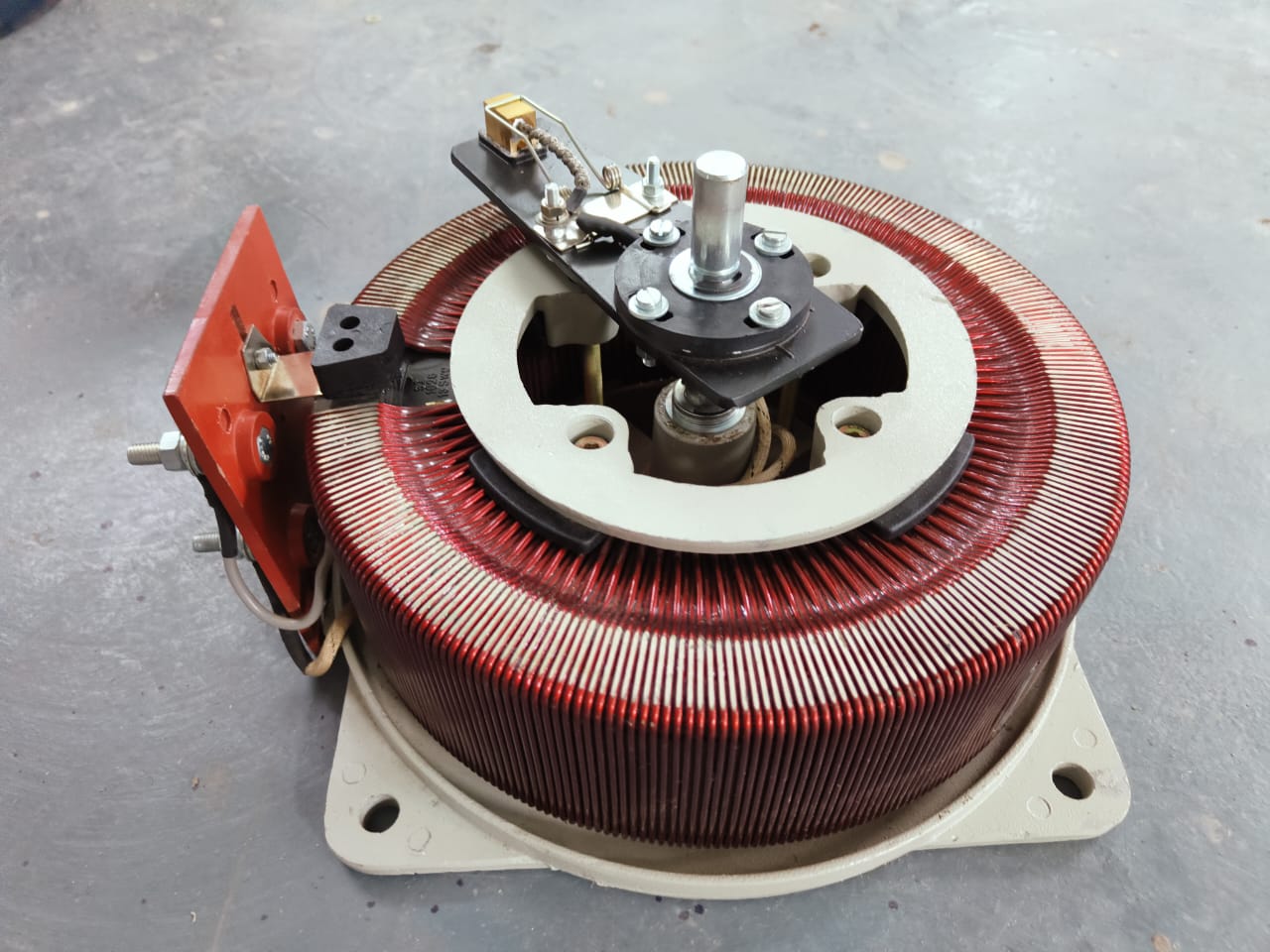
Auto Transformer / Varriac / Dimmer
An Auto Transformer / Varriac / Dimmer, commonly known as a Variac, is a type of transformer used to vary the output voltage from zero to a maximum value. It is widely used in electrical engineering and various applications where adjustable voltage is required.
Components of a Variac Dimmer
- Core: The core of the Variac is usually made of laminated silicon steel, which reduces core losses and enhances efficiency.
- Windings: It has a single winding that acts both as primary and secondary. The winding is made of copper or aluminum.
- Brush: A movable brush contacts the winding, allowing the user to adjust the output voltage.
- Dial/Knob: A dial or knob is connected to the brush, providing a user-friendly interface to adjust the voltage.
- Output Terminals: Terminals where the adjusted voltage is output.
Working Principle
The Variac works on the principle of electromagnetic induction. When an AC voltage is applied to the input, it creates a magnetic field in the core, inducing a voltage in the winding. By moving the brush along the winding, the effective turns ratio changes, which in turn adjusts the output voltage.
Applications
- Testing and Development: Used in laboratories for testing electronic equipment by providing adjustable voltage.
- Lighting Control: Used in theatrical lighting systems to adjust the brightness of lights.
- Voltage Regulation: Used in applications requiring precise voltage control, such as in motor speed control.
- Audio Equipment: Used in audio applications to prevent equipment damage by providing a gradual increase in voltage.
Advantages
- Smooth Voltage Control: Provides a continuous range of output voltage.
- High Efficiency: Minimal energy loss during voltage transformation.
- Durability: Robust construction ensures long life and reliable performance.
- Versatility: Can be used for various applications requiring adjustable voltage.
Choosing the Right Variac Dimmer
- Voltage and Current Rating: Select based on the required output voltage and current.
- Power Rating: Ensure it can handle the power requirements of the application.
- Build Quality: Opt for models with sturdy construction for long-term reliability.
- Additional Features: Consider features like digital displays, overload protection, and remote control options.